Tiger Moth
1930's Aviation
1930's Aviation
Local 10 Jul 26
Not quite The Dark Side, but tailwheel aircraft are something I have always avoided. They are notoriously tricky to land, especially in any sort of crosswind, and taxying can be prone to disaster. Theres a good reason the world migrated across to nose wheels in the 1940’s. Apart from the British light aircraft ind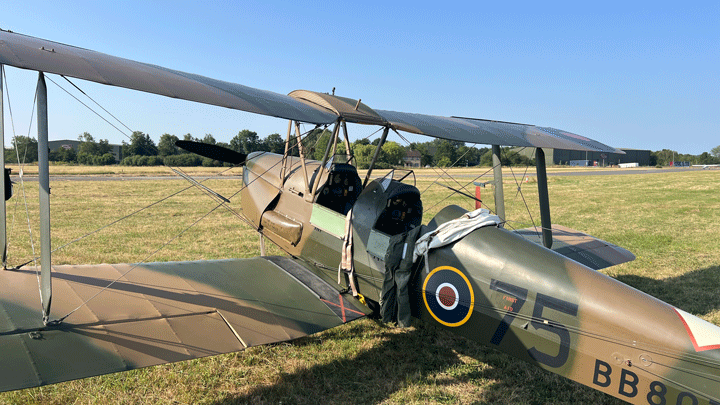 ustry, of course, that persisted with tail wheels until the 1960’s and wondered why people bought American aircraft instead….
There are Moths at Henstridge, and I’ve often wondered about doing the full Biggles biplane, 1st World War flying helmet and ‘Chocks away’ thing.
So I ask Annabelle at Tiger Moth Training if she thinks a taller man like me might fit in a Moth, and surprisingly she says “yes.”
The UK’s heatwave continues, and we opt for an 8:00am start to escape the worst of the heat. It’s hot, but not afternoon stinky lie-in-a-chair type hot. It will be, later.
This is opportunity to relive 1930’s RAF training, and maybe a little Biggles. Of the two aircraft they have, one is currently failing to smart but BB803 is ready and willing.
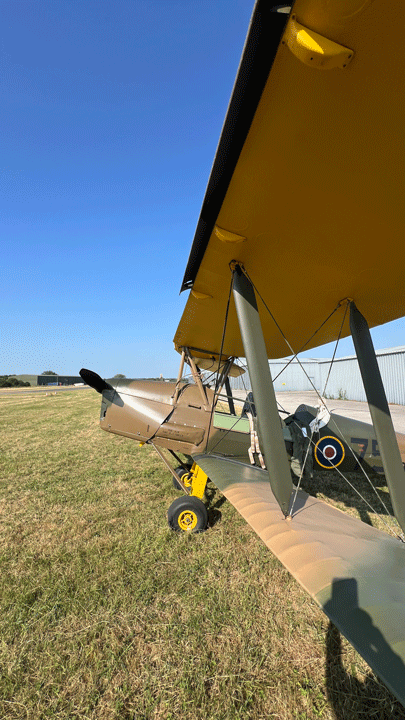
A thorough pre-flight briefing including forced landings and “Annabelle inflight heart attack” landing options ensues, she then explains that I will need to use the footrests, I mean the rudder pedals, in flight. This aircraft, like all manufactured before 1960, require coordinated use of rudder in and out of turns lest the secondary effects of the controls, especially the ailerons give you the opposite effect to the one desired. In other words, as she soon demonstrates, right aileron makes the aircraft turn left!
The first thing you notice is that this is not a little dainty aircraft. It's quite beefy and muscular, and tall. You climb up on the lower wing, minding the 'No Step' red X and swing your leg over to enter the cockpit, which is surprisingly roomy and solid-feeling, given that we are led to believe everyone in the 1930's was undernourished. Stand on the seat, sit down and strap in to the 4-point harness, not unlike the old Chipmunk harness I remember. An Active noise cancelling flying helmet helps with the noise and everything feels quite civilised.
The cockpit is an ergonomic nightmare: the instruments are very close to you, many of the instruments and controls are either semi-visible or hiden behind large, sharp-edged nuts. But the controls are more like the gliders I originally flew back in the late-1970’s when all things except, as it turns out, an RAF flying career, appeared possible.
Taxying requires a gentle touch, turns only really on grass surfaces as it's a tailskid and weaving because you can’t see out the front with the tail on the ground. Who’s stupid idea was that? I can't help think that putting the wings and main wheels a little further back would have allowed for a nosewheel. It's all in the CG, after all.
One thing the cockpit does have is a rear view mirror, that is utterly useless from the moment the engne is (manually) started due to the vibration.
I don't have the guts to do the take off as you need to push the stick forward and with no noseweheel to get in the way, a prop strike seems inevitable. Annabelle knows exactly what a level fuselage looks like but I don't and visions of a shock-loaded engnie and bent prop assault me...
We climb out and, after a little hesitancy, it turns out I can fly it OK. It’s not powerful, but it’s a solid, if draggy, airframe, that can be persuaded in to steep turns, spins and aerobatics. Annabelle is in demand for displays and this 'Heritage' aircraft can even fly around Stalbridge, notorious for its noise complaints: “I bought a house near an airfield. Why are those noisy aircraft here? And it’s in the country, why are those noisy tractors and foul farmyard smells here?” I am contemplating starting a ‘Get a Bloody Grip’ political party…
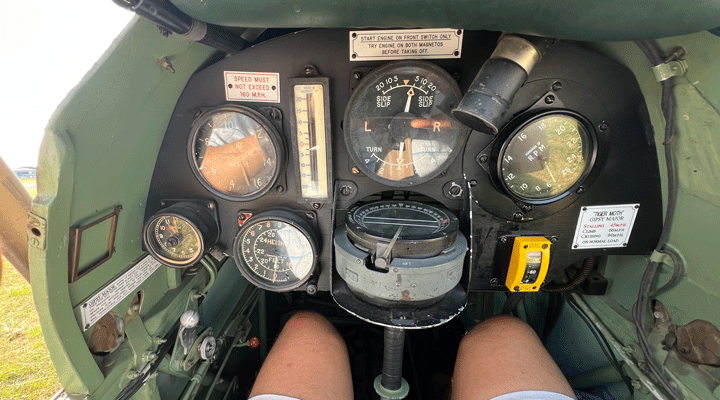 Straight and level is easy: the X of wires in front of me line up nicely with the horizon. Climbs and descents are easy, you just need to keep the ASI and Turn/Slip indicator in your perpheral vision.
The view is of course staggering: no side windows, just a little windscreen to keep the worst of the slipstream at bay and those wings high above you to keep the sun off you. And the cockpit sides are low, not great for vertigo sufferers. But this is an aircraft designed to train pilots and weed out the unsuitable (me, apparently, according to the RAF Medical wonks) from another, less politically correct era.
The stall is a non-event, and quite hard to precipitate, simply requiring a good solid push to unstick it and retract the leading edge slats that act as stall warners. We won’t spin it today, but apparently “just let go” is the preferred recovery method, although I suspect out spin rudder may help… A sideslip is great fun and you can really feel the side wind. I believe that with practice the slipstream feel from both sides would allow you to fly it wthout reference to the Turn/Slip indicator. Wolfgan Langewiesche's seminal 'Stick and Rudder' aviation bible is even more relevant to this aircraft than a modern metal monoplane.
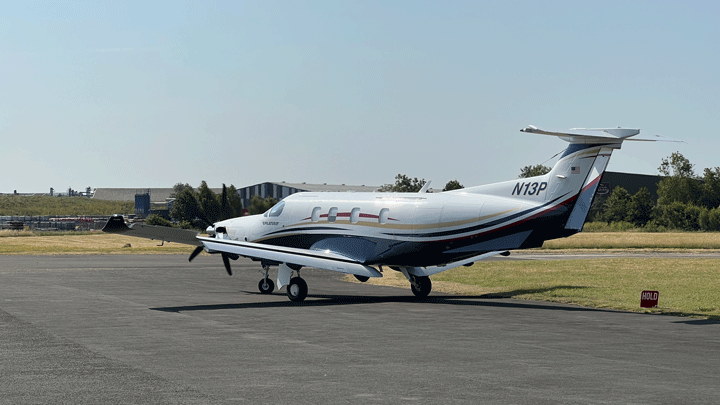
You really do have to handle it properly. I can imagine it’s hard to fly IMC and even harder to land well. Having frightened the good burghers of our village with some steep turns we return to the circuit to dance with the other traffic. I’ve gained sufficient confidence to fly an approach, but half way down final the Air Ambulance is hovering for a landing, so having had experience of the rotor a large, hovering helicopter can generate we both agree a go around is the best option here. The second approach is OK but I’m high and fast so bottle it: Annabelle swiftly and decisively sideslips my excess height and speed, neatly lands it then abruptly swerves off the tarmac directly in to the path of a parked Pilatus PC-12. We’re all going to die! No, she wants the grass runway because we have no brakes…
 That was a great deal of fun, and I may do it again, and a real window into what aviation used to be like when they were still learning about aerodynamics, cockpit ergonomics, stressed alloy monocoque airframe construction and stress analysis. My feet will from now on never sit still on the footrests. Although ever since my IMC Nav revelations I do actually always fly the aircraft in balance.
The PC-12 departs later with an incredible 350m take off roll and less noise than a PA-28. I want one.